When a choice feels narrower because of pressure, compulsion, or a familiar trap, pause before calling it a free decision.
Attachment · Compulsion · Choice
Our interpretation: a way to notice attachment and restore choice, not proof that someone is evil, a relationship is doomed, or a habit defines your character.
Attraction and attachment can look similar at first. Look at what happens before, during, and after the choice: what draws you in, what it costs, and whether you can still choose something else.
Should I go back to this intense connection?
Intensity can be meaningful, but it is not proof of compatibility or safety. Look at the whole pattern: how conflict ends, whether boundaries are respected, and whether you can be honest without fearing the response.
What makes it compelling
The chemistry, shared history, hope for change, and relief from loneliness or uncertainty can all be real.
What it may be costing
Notice anxiety, isolation, repeated betrayals, walking on eggshells, or needing to abandon your own judgment to stay close.
Should I accept one more commitment at work?
Being needed can feel like evidence of value, especially when rest or delegation feels uncomfortable. Before saying yes, check whether this is a deliberate priority or an old rule that says you must earn your place by never refusing.
What makes it compelling
Recognition, momentum, fear of disappointing people, and the temporary relief of avoiding a difficult no.
What it may be costing
Chronic exhaustion, reduced judgment, resentment, missed commitments elsewhere, and less room to choose your actual priorities.
Should I try to change this habit now?
Change is easier to approach when you understand the loop rather than relying on shame. Notice what the habit provides, what it costs, and which small alternative could meet some of the same need with less harm.
What makes it compelling
Comfort, distraction, stimulation, social belonging, or a brief escape from an emotion you do not want to feel.
What it may be costing
Lost time, money, sleep, trust, health, or the growing sense that the choice is happening on autopilot.
Map the loop
Four Moments That Keep a Pattern Alive
A habit rarely survives on pleasure alone. It often works because it offers relief before the full cost arrives. Write down the last time it happened and identify these four moments.
01
Trigger · The narrowing
Something happens: loneliness, stress, praise, conflict, boredom, or an old memory. Your options may suddenly feel fewer, as if only one response will make the feeling stop.
What happened just before I wanted the familiar response?02
Relief · The short reward
The action gives you something immediate: comfort, distraction, belonging, control, or a break from discomfort. This is why the pattern repeats; its short-term usefulness is real.
What did I get in the first few seconds or minutes?03
Cost · The delayed bill
Later, the consequences arrive: regret, lost time, conflict, exhaustion, secrecy, or another responsibility you did not want. The mind may rewrite these costs as the price you must pay to survive.
What happened afterward, and what did it cost me or someone else?04
Return · The next trigger
Shame, self-criticism, or another uncomfortable feeling can become the next trigger. The cycle starts again, now with the added belief that you cannot change it.
What would make the next round more likely, and where could I interrupt it?
Understanding the reward does not excuse the harm. It gives you somewhere practical to intervene: before the trigger, during the choice, or after the cost, when shame tries to restart the loop.
Check the Freedom Inside the Choice
The key question is not whether a relationship, job, or habit looks powerful. It is whether you still have meaningful room to choose.
Can I say no without punishment?
A clear refusal should not lead to threats, intimidation, withdrawal of basic support, or fear for your safety. If a no carries those risks, the issue is bigger than a tarot reading.
Can I change my mind?
Look for room to renegotiate, pause, leave, or revise the arrangement. If every change brings escalating pressure, the appearance of choice may be narrower than it first seemed.
Can I ask for support?
You should be able to speak to someone you trust, consult a qualified professional, or get practical help. Isolation makes unhealthy patterns stronger; support can restore perspective and options.
Yes, Not Yet, or No: Restore the Choice First
The answer here is about the pattern, not about condemning yourself for having it.
Yes · Name it and make room
You can see the pattern clearly enough to work with it. Take a small boundary, ask for support, change the environment, or choose a safer alternative that restores some freedom.
Not yet · Get support before acting alone
The choice is entangled with fear, dependence, or missing information. Do not force a dramatic breakthrough if you need clearer facts, another person, or professional support first.
No · Do not call coercion a choice
Refuse the idea that pressure, shame, or fear must be the price of love, belonging, or success. If the pattern requires those conditions, changing it matters more than finding the perfect interpretation.
One practical next step
Build an Exit Ramp, Not a Grand Escape Plan
A pattern is harder to interrupt when your only plan is ‘never again.’ Choose one small change that creates a real alternative and does not depend on perfect willpower.
1
Name one early warning sign
Choose the moment you usually notice too late: a particular message, time of day, criticism, invitation, or feeling. Write it as a concrete cue, not a flaw in your character.
2
Prepare one alternative response
Delay the answer, step away, message a trusted person, eat or rest first, or use a less harmful source of the same comfort. Keep the response small enough to remember.
3
Change one condition around the loop
Remove a cue, move an app, set a spending or contact limit, move a conversation to daylight, or arrange support in advance. Make the alternative easier to reach than the old pattern.
A concrete example‘When I want to reply immediately after an argument, I will wait twenty minutes, put the phone in another room, and write what I want to say before deciding whether to send it. If waiting still feels unsafe, I will contact someone I trust.’
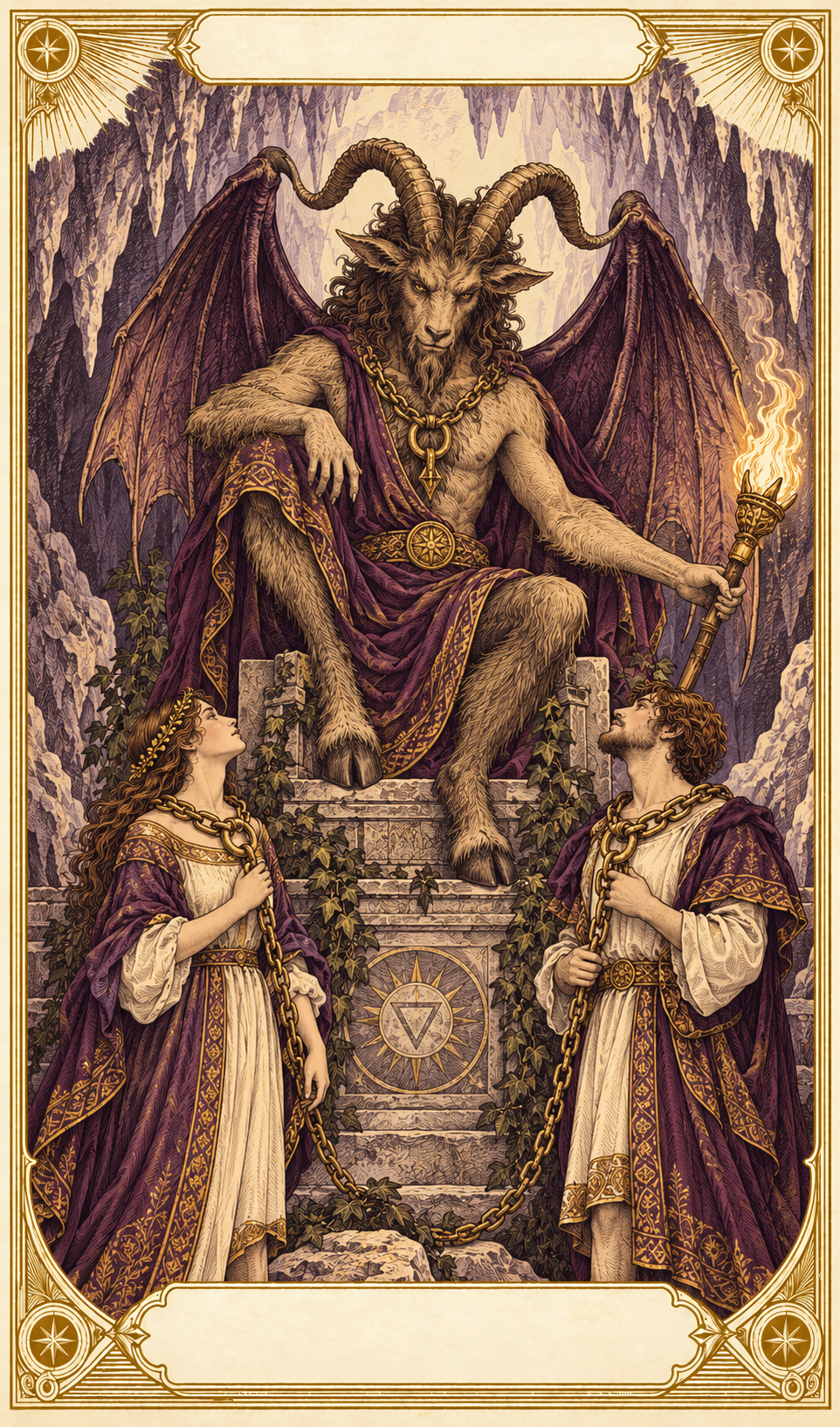
Attachment in the Details of Our Devil Card
These editorial notes interpret three visible elements in our illustration.
01The chains around the figures
The linked figures make constraint visible. We use the chains as a prompt to notice where a choice has become narrow, without assuming that the people in the scene are incapable of change.
02The figure on the throne
The elevated figure dominates the composition. In our reading, it represents the authority a pattern can gain over attention: something powerful can start to feel unquestionable simply because it is familiar.
03The flame at the side
The flame provides a sharp point of energy beside the static throne. We interpret it as a reminder that intensity itself is neutral; what matters is whether you can direct it or it keeps directing you.
What would make your next choice feel more like your own?
Use a reading to name the pattern, then look for the boundary, information, or support that gives you more room to act.
First single-card reading free. No account needed.
Questions About The Devil
Does The Devil mean a relationship is toxic or doomed?
Not by itself. It asks you to examine attachment and freedom, not to diagnose a person or relationship. Look at fear, consent, boundaries, isolation, and what happens when you say no.
Does The Devil mean I have an addiction?
A tarot card cannot diagnose addiction or any other condition. If a habit feels out of control, affects your health, money, safety, or relationships, consider speaking with a qualified professional and someone you trust.
Is intense attraction always a warning sign?
No. Attraction can be joyful and meaningful. The useful question is what happens around it: whether you can be honest, change your mind, keep other relationships, and make choices without fear or shame.